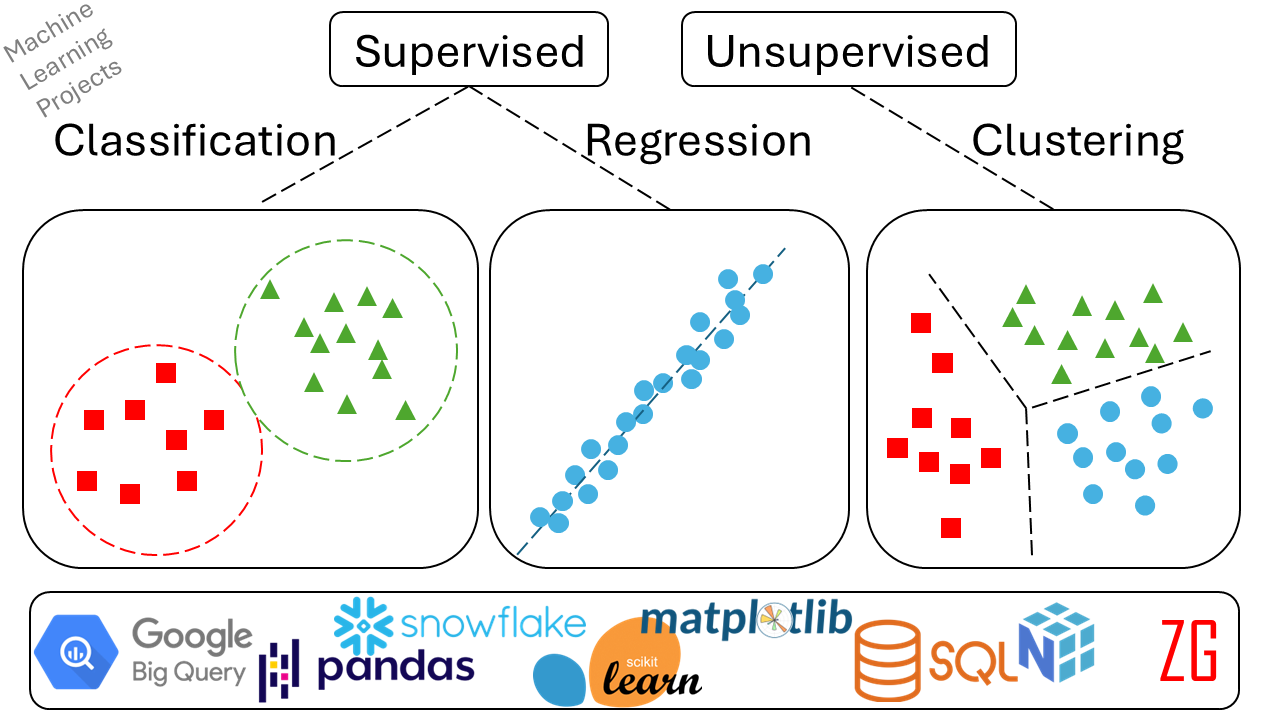
Income Class Classification: Data Cleaning, EDA, and ML Modeling#
# This data was extracted from the 1994 Census bureau database by Ronny Kohavi and Barry Becker (Data Mining and Visualization, Silicon Graphics). A set of reasonably clean records was extracted using the following conditions: ((AAGE>16) && (AGI>100) && (AFNLWGT>1) && (HRSWK>0)). The prediction task is to determine whether a person makes over $50K a year.
# Dataset source:# https://www.kaggle.com/datasets/uciml/adult-census-income
import pandas as pd
import numpy as np

df = pd.read_csv("../data/adult.csv")

print(df.head())
   age workclass  fnlwgt     education  education.num marital.status  \
0   90         ?   77053       HS-grad              9        Widowed
1   82   Private  132870       HS-grad              9        Widowed
2   66         ?  186061  Some-college             10        Widowed
3   54   Private  140359       7th-8th              4       Divorced
4   41   Private  264663  Some-college             10      Separated

          occupation   relationship   race     sex  capital.gain  \
0                  ?  Not-in-family  White  Female             0
1    Exec-managerial  Not-in-family  White  Female             0
2                  ?      Unmarried  Black  Female             0
3  Machine-op-inspct      Unmarried  White  Female             0
4     Prof-specialty      Own-child  White  Female             0

   capital.loss  hours.per.week native.country income
0          4356              40  United-States  <=50K
1          4356              18  United-States  <=50K
2          4356              40  United-States  <=50K
3          3900              40  United-States  <=50K
4          3900              40  United-States  <=50K
print(df.tail())
       age workclass  fnlwgt     education  education.num      marital.status  \
32556   22   Private  310152  Some-college             10       Never-married
32557   27   Private  257302    Assoc-acdm             12  Married-civ-spouse
32558   40   Private  154374       HS-grad              9  Married-civ-spouse
32559   58   Private  151910       HS-grad              9             Widowed
32560   22   Private  201490       HS-grad              9       Never-married

              occupation   relationship   race     sex  capital.gain  \
32556    Protective-serv  Not-in-family  White    Male             0
32557       Tech-support           Wife  White  Female             0
32558  Machine-op-inspct        Husband  White    Male             0
32559       Adm-clerical      Unmarried  White  Female             0
32560       Adm-clerical      Own-child  White    Male             0

       capital.loss  hours.per.week native.country income
32556             0              40  United-States  <=50K
32557             0              38  United-States  <=50K
32558             0              40  United-States   >50K
32559             0              40  United-States  <=50K
32560             0              20  United-States  <=50K
print(df.shape)
(32561, 15)
print(df.info())
<class 'pandas.core.frame.DataFrame'>
RangeIndex: 32561 entries, 0 to 32560
Data columns (total 15 columns):
 #   Column          Non-Null Count  Dtype
---  ------          --------------  -----
 0   age             32561 non-null  int64
 1   workclass       32561 non-null  object
 2   fnlwgt          32561 non-null  int64
 3   education       32561 non-null  object
 4   education.num   32561 non-null  int64
 5   marital.status  32561 non-null  object
 6   occupation      32561 non-null  object
 7   relationship    32561 non-null  object
 8   race            32561 non-null  object
 9   sex             32561 non-null  object
 10  capital.gain    32561 non-null  int64
 11  capital.loss    32561 non-null  int64
 12  hours.per.week  32561 non-null  int64
 13  native.country  32561 non-null  object
 14  income          32561 non-null  object
dtypes: int64(6), object(9)
memory usage: 3.7+ MB
None
print(df.describe())
                age        fnlwgt  education.num  capital.gain  capital.loss  \
count  32561.000000  3.256100e+04   32561.000000  32561.000000  32561.000000
mean      38.581647  1.897784e+05      10.080679   1077.648844     87.303830
std       13.640433  1.055500e+05       2.572720   7385.292085    402.960219
min       17.000000  1.228500e+04       1.000000      0.000000      0.000000
25%       28.000000  1.178270e+05       9.000000      0.000000      0.000000
50%       37.000000  1.783560e+05      10.000000      0.000000      0.000000
75%       48.000000  2.370510e+05      12.000000      0.000000      0.000000
max       90.000000  1.484705e+06      16.000000  99999.000000   4356.000000

       hours.per.week
count    32561.000000
mean        40.437456
std         12.347429
min          1.000000
25%         40.000000
50%         40.000000
75%         45.000000
max         99.000000
print(df.isna().sum())
age               0
workclass         0
fnlwgt            0
education         0
education.num     0
marital.status    0
occupation        0
relationship      0
race              0
sex               0
capital.gain      0
capital.loss      0
hours.per.week    0
native.country    0
income            0
dtype: int64
df.columns
Index(['age', 'workclass', 'fnlwgt', 'education', 'education.num',
       'marital.status', 'occupation', 'relationship', 'race', 'sex',
       'capital.gain', 'capital.loss', 'hours.per.week', 'native.country',
       'income'],
      dtype='object')
print(df.dtypes)
age                int64
workclass         object
fnlwgt             int64
education         object
education.num      int64
marital.status    object
occupation        object
relationship      object
race              object
sex               object
capital.gain       int64
capital.loss       int64
hours.per.week     int64
native.country    object
income            object
dtype: object
object columns are Categorical, and int64 columns are Numerical.
df["occupation"].value_counts()
occupation
Prof-specialty       4140
Craft-repair         4099
Exec-managerial      4066
Adm-clerical         3770
Sales                3650
Other-service        3295
Machine-op-inspct    2002
?                    1843
Transport-moving     1597
Handlers-cleaners    1370
Farming-fishing       994
Tech-support          928
Protective-serv       649
Priv-house-serv       149
Armed-Forces            9
Name: count, dtype: int64
categ_col = ["workclass", "education","marital.status", "occupation", "relationship",
                "race", "sex", "native.country", "income"]
for col in categ_col:
    print(f"\n--- {col} ---")
    print(df[col].value_counts())
--- workclass ---
workclass
Private             22696
Self-emp-not-inc     2541
Local-gov            2093
?                    1836
State-gov            1298
Self-emp-inc         1116
Federal-gov           960
Without-pay            14
Never-worked            7
Name: count, dtype: int64

--- education ---
education
HS-grad         10501
Some-college     7291
Bachelors        5355
Masters          1723
Assoc-voc        1382
11th             1175
Assoc-acdm       1067
10th              933
7th-8th           646
Prof-school       576
9th               514
12th              433
Doctorate         413
5th-6th           333
1st-4th           168
Preschool          51
Name: count, dtype: int64

--- marital.status ---
marital.status
Married-civ-spouse       14976
Never-married            10683
Divorced                  4443
Separated                 1025
Widowed                    993
Married-spouse-absent      418
Married-AF-spouse           23
Name: count, dtype: int64

--- occupation ---
occupation
Prof-specialty       4140
Craft-repair         4099
Exec-managerial      4066
Adm-clerical         3770
Sales                3650
Other-service        3295
Machine-op-inspct    2002
?                    1843
Transport-moving     1597
Handlers-cleaners    1370
Farming-fishing       994
Tech-support          928
Protective-serv       649
Priv-house-serv       149
Armed-Forces            9
Name: count, dtype: int64

--- relationship ---
relationship
Husband           13193
Not-in-family      8305
Own-child          5068
Unmarried          3446
Wife               1568
Other-relative      981
Name: count, dtype: int64

--- race ---
race
White                 27816
Black                  3124
Asian-Pac-Islander     1039
Amer-Indian-Eskimo      311
Other                   271
Name: count, dtype: int64

--- sex ---
sex
Male      21790
Female    10771
Name: count, dtype: int64

--- native.country ---
native.country
United-States                 29170
Mexico                          643
?                               583
Philippines                     198
Germany                         137
Canada                          121
Puerto-Rico                     114
El-Salvador                     106
India                           100
Cuba                             95
England                          90
Jamaica                          81
South                            80
China                            75
Italy                            73
Dominican-Republic               70
Vietnam                          67
Guatemala                        64
Japan                            62
Poland                           60
Columbia                         59
Taiwan                           51
Haiti                            44
Iran                             43
Portugal                         37
Nicaragua                        34
Peru                             31
Greece                           29
France                           29
Ecuador                          28
Ireland                          24
Hong                             20
Cambodia                         19
Trinadad&Tobago                  19
Laos                             18
Thailand                         18
Yugoslavia                       16
Outlying-US(Guam-USVI-etc)       14
Hungary                          13
Honduras                         13
Scotland                         12
Holand-Netherlands                1
Name: count, dtype: int64

--- income ---
income
<=50K    24720
>50K      7841
Name: count, dtype: int64
df['workclass'] = df['workclass'].replace('?', 'Unknown')
df['occupation'] = df['occupation'].replace('?', 'Unknown')
Like done previously, those missing values might be labelled as Unknown, I do prefer filling them via Mode which is the most repeated valu of the column. Over 90% of native.country data is “United-States.” Statistically, there is a massive chance those 583 missing values are also US-based.
# find mode of the specific column
country_missing = df["native.country"].mode()[0]

# fill the missing ? native country values with those mode.
df["native.country"] = df["native.country"].replace("?", country_missing)
Native.country column has only 1 labelled as Holand-Netherlands value, which is outlier. Having only 1 row for a country is “noise.” Machine learning models can’t learn anything from a single example; it actually makes it harder for the model to generalize.
df = df[df['native.country'] != 'Holand-Netherlands']
df.head()
| age | workclass | fnlwgt | education | education.num | marital.status | occupation | relationship | race | sex | capital.gain | capital.loss | hours.per.week | native.country | income | |
|---|---|---|---|---|---|---|---|---|---|---|---|---|---|---|---|
| 0 | 90 | Unknown | 77053 | HS-grad | 9 | Widowed | Unknown | Not-in-family | White | Female | 0 | 4356 | 40 | United-States | <=50K |
| 1 | 82 | Private | 132870 | HS-grad | 9 | Widowed | Exec-managerial | Not-in-family | White | Female | 0 | 4356 | 18 | United-States | <=50K |
| 2 | 66 | Unknown | 186061 | Some-college | 10 | Widowed | Unknown | Unmarried | Black | Female | 0 | 4356 | 40 | United-States | <=50K |
| 3 | 54 | Private | 140359 | 7th-8th | 4 | Divorced | Machine-op-inspct | Unmarried | White | Female | 0 | 3900 | 40 | United-States | <=50K |
| 4 | 41 | Private | 264663 | Some-college | 10 | Separated | Prof-specialty | Own-child | White | Female | 0 | 3900 | 40 | United-States | <=50K |
# Dropping 'fnlwgt' because it represents census sampling weights rather than
# individual characteristics. It generally doesn't help predict a person's income.
df = df.drop('fnlwgt', axis=1)
df.columns
Index(['age', 'workclass', 'education', 'education.num', 'marital.status',
       'occupation', 'relationship', 'race', 'sex', 'capital.gain',
       'capital.loss', 'hours.per.week', 'native.country', 'income'],
      dtype='object')
print(df["education"].value_counts())
print(df["education.num"].value_counts())
education
HS-grad         10501
Some-college     7290
Bachelors        5355
Masters          1723
Assoc-voc        1382
11th             1175
Assoc-acdm       1067
10th              933
7th-8th           646
Prof-school       576
9th               514
12th              433
Doctorate         413
5th-6th           333
1st-4th           168
Preschool          51
Name: count, dtype: int64
education.num
9     10501
10     7290
13     5355
14     1723
11     1382
7      1175
12     1067
6       933
4       646
15      576
5       514
8       433
16      413
3       333
2       168
1        51
Name: count, dtype: int64
Current column names (like education.num and marital.status) use dots, which can cause issues in certain Python libraries (like Scikit-learn) or when using the df.column_name dot-notation in pandas.
# Direct rename to get rid of dots
df = df.rename(columns={
    "education.num": "education_num",
    "marital.status": "marital_status",
    "capital.gain": "capital_gain",
    "capital.loss": "capital_loss",
    "hours.per.week": "hours_per_week",
    "native.country": "native_country"
})
print(df.columns.tolist())
['age', 'workclass', 'education', 'education_num', 'marital_status', 'occupation', 'relationship', 'race', 'sex', 'capital_gain', 'capital_loss', 'hours_per_week', 'native_country', 'income']
Classification#
import pandas as pd
import numpy as np
import joblib

from sklearn.model_selection import train_test_split, RandomizedSearchCV
from sklearn.compose import ColumnTransformer
from sklearn.pipeline import Pipeline
from sklearn.preprocessing import OneHotEncoder, StandardScaler

from sklearn.linear_model import LogisticRegression
from sklearn.tree import DecisionTreeClassifier
from sklearn.ensemble import RandomForestClassifier, GradientBoostingClassifier

from sklearn.metrics import (
    accuracy_score,
    precision_score,
    recall_score,
    f1_score,
    classification_report,
    confusion_matrix
)
X = df.drop("income", axis=1)
y = df["income"]
# first cut: 80 train, 20 temp
X_train, X_temp, y_train, y_temp = train_test_split(
    X, y,
    test_size=0.20,
    random_state=42,
    stratify=y
)

# second cut: 10 validation, 10 test
X_val, X_test, y_val, y_test = train_test_split(
    X_temp, y_temp,
    test_size=0.50,
    random_state=42,
    stratify=y_temp
)

print("X_train shape:", X_train.shape)
print("X_val shape  :", X_val.shape)
print("X_test shape :", X_test.shape)

print("y_train shape:", y_train.shape)
print("y_val shape  :", y_val.shape)
print("y_test shape :", y_test.shape)
X_train shape: (26048, 13)
X_val shape  : (3256, 13)
X_test shape : (3256, 13)
y_train shape: (26048,)
y_val shape  : (3256,)
y_test shape : (3256,)
y_train = y_train.str.strip().map({"<=50K": 0, ">50K": 1})
y_val   = y_val.str.strip().map({"<=50K": 0, ">50K": 1})
y_test  = y_test.str.strip().map({"<=50K": 0, ">50K": 1})
categorical_cols = X_train.select_dtypes(include="object").columns.tolist()
numerical_cols = X_train.select_dtypes(include=["int64", "float64"]).columns.tolist()

print("Categorical columns:", categorical_cols)
print("Numerical columns:", numerical_cols)
Categorical columns: ['workclass', 'education', 'marital_status', 'occupation', 'relationship', 'race', 'sex', 'native_country']
Numerical columns: ['age', 'education_num', 'capital_gain', 'capital_loss', 'hours_per_week']
preprocessor = ColumnTransformer(
    transformers=[
        ("num", StandardScaler(), numerical_cols),
        ("cat", OneHotEncoder(handle_unknown="ignore"), categorical_cols)
    ]
)
models = {
    "Logistic Regression": LogisticRegression(random_state=42, max_iter=2000),
    "Decision Tree": DecisionTreeClassifier(random_state=42),
    "Random Forest": RandomForestClassifier(random_state=42),
    "Gradient Boosting": GradientBoostingClassifier(random_state=42)
}
param_distributions = {
    "Logistic Regression": {
        "model__C": np.logspace(-3, 2, 20),
        "model__solver": ["liblinear", "lbfgs"],
        "model__penalty": ["l2"]
    },

    "Decision Tree": {
        "model__max_depth": [None, 5, 10, 15, 20, 30],
        "model__min_samples_split": [2, 5, 10, 20],
        "model__min_samples_leaf": [1, 2, 4, 8],
        "model__criterion": ["gini", "entropy"]
    },

    "Random Forest": {
        "model__n_estimators": [100, 200],
        "model__max_depth": [None, 10, 20],
        "model__min_samples_split": [2, 5],
        "model__min_samples_leaf": [1, 2],
        "model__max_features": ["sqrt", "log2"]
    },


    "Gradient Boosting": {

        "model__n_estimators": [100, 200],
        "model__learning_rate": [0.05, 0.1],
        "model__max_depth": [3, 4],
        "model__min_samples_split": [2, 5],
        "model__min_samples_leaf": [1, 2]

    }
}
tuned_models = {}
results = []

for model_name, model in models.items():
    print(f"\n{'='*60}")
    print(f"Running RandomizedSearchCV for: {model_name}")
    print(f"{'='*60}")

    pipeline = Pipeline([
        ("preprocessor", preprocessor),
        ("model", model)
    ])

    random_search = RandomizedSearchCV(
        estimator=pipeline,
        param_distributions=param_distributions[model_name],
        n_iter=15,
        scoring="f1",
        cv=5,
        verbose=3,
        random_state=42,
        n_jobs=-1
    )

    random_search.fit(X_train, y_train)

    best_model = random_search.best_estimator_
    tuned_models[model_name] = best_model

    y_val_pred = best_model.predict(X_val)

    acc = accuracy_score(y_val, y_val_pred)
    prec = precision_score(y_val, y_val_pred)
    rec = recall_score(y_val, y_val_pred)
    f1 = f1_score(y_val, y_val_pred)

    results.append({
        "model": model_name,
        "best_cv_f1": random_search.best_score_,
        "val_accuracy": acc,
        "val_precision": prec,
        "val_recall": rec,
        "val_f1": f1,
        "best_params": random_search.best_params_
    })
============================================================
Running RandomizedSearchCV for: Logistic Regression
============================================================
Fitting 5 folds for each of 15 candidates, totalling 75 fits

============================================================
Running RandomizedSearchCV for: Decision Tree
============================================================
Fitting 5 folds for each of 15 candidates, totalling 75 fits

============================================================
Running RandomizedSearchCV for: Random Forest
============================================================
Fitting 5 folds for each of 15 candidates, totalling 75 fits

============================================================
Running RandomizedSearchCV for: Gradient Boosting
============================================================
Fitting 5 folds for each of 15 candidates, totalling 75 fits
results_df = pd.DataFrame(results).sort_values(by="val_f1", ascending=False)

print(results_df[["model", "best_cv_f1", "val_accuracy", "val_precision", "val_recall", "val_f1"]])
                 model  best_cv_f1  val_accuracy  val_precision  val_recall  \
3    Gradient Boosting    0.712974      0.865172       0.776000    0.618622
2        Random Forest    0.686117      0.859951       0.759494    0.612245
0  Logistic Regression    0.657668      0.850737       0.735759    0.593112
1        Decision Tree    0.666943      0.852273       0.783178    0.534439

     val_f1
3  0.688432
2  0.677966
0  0.656780
1  0.635330
best_model_name = results_df.iloc[0]["model"]
print("Best tuned model:", best_model_name)

best_final_model = tuned_models[best_model_name]

joblib.dump(best_final_model, "best_adult_income_model.pkl")
print("Best model saved as best_adult_income_model.pkl")
Best tuned model: Gradient Boosting
Best model saved as best_adult_income_model.pkl
y_val_pred_best = best_final_model.predict(X_val)

print("Validation Accuracy :", accuracy_score(y_val, y_val_pred_best))
print("Validation Precision:", precision_score(y_val, y_val_pred_best))
print("Validation Recall   :", recall_score(y_val, y_val_pred_best))
print("Validation F1       :", f1_score(y_val, y_val_pred_best))

print("\nConfusion Matrix:")
print(confusion_matrix(y_val, y_val_pred_best))

print("\nClassification Report:")
print(classification_report(y_val, y_val_pred_best))
Validation Accuracy : 0.8651719901719902
Validation Precision: 0.776
Validation Recall   : 0.6186224489795918
Validation F1       : 0.6884315117104329

Confusion Matrix:
[[2332  140]
 [ 299  485]]

Classification Report:
              precision    recall  f1-score   support

           0       0.89      0.94      0.91      2472
           1       0.78      0.62      0.69       784

    accuracy                           0.87      3256
   macro avg       0.83      0.78      0.80      3256
weighted avg       0.86      0.87      0.86      3256
y_test_pred = best_final_model.predict(X_test)

print("Test Accuracy :", accuracy_score(y_test, y_test_pred))
print("Test Precision:", precision_score(y_test, y_test_pred))
print("Test Recall   :", recall_score(y_test, y_test_pred))
print("Test F1       :", f1_score(y_test, y_test_pred))

print("\nTest Confusion Matrix:")
print(confusion_matrix(y_test, y_test_pred))

print("\nTest Classification Report:")
print(classification_report(y_test, y_test_pred))
Test Accuracy : 0.8777641277641277
Test Precision: 0.7924242424242425
Test Recall   : 0.6670918367346939
Test F1       : 0.724376731301939

Test Confusion Matrix:
[[2335  137]
 [ 261  523]]

Test Classification Report:
              precision    recall  f1-score   support

           0       0.90      0.94      0.92      2472
           1       0.79      0.67      0.72       784

    accuracy                           0.88      3256
   macro avg       0.85      0.81      0.82      3256
weighted avg       0.87      0.88      0.87      3256